EXERCISE 5.3
Arithmetic Progressions • 20 Questions
Question 1
Hint available
Find the sum of the following APs: (i) 2, 7, 12, . . ., to 10 terms. (ii) –37, –33, –29, . . ., to 12 terms. (iii) 0.6, 1.7, 2.8, . . ., to 100 terms. (iv) 1 1 1 , , 15 12 10 , . . ., to 11 terms.
Key Idea
For an arithmetic progression (AP) with first term \(a\), common difference \(d\) and \(n\) terms, the sum is given by \[ S_n = \frac{n}{2}\bigl[2a+(n-1)d\bigr] \] or equivalently \[ S_n = \frac{n}{2}(a + l) \] where \(l = a+(n-1)d\) is the last term. The method is to identify \(a\), \(d\) and \(n\) for each series, compute the last term (if convenient) and then apply the formula.
Step-by-Step Solution
1. Series (i)
- First term \(a = 2\).
- Common difference \(d = 7-2 = 5\).
- Number of terms \(n = 10\).
- Last term \(l = a+(n-1)d = 2+9\times5 = 47\).
- Sum \(S_{10}=\frac{10}{2}(a+l)=5\times(2+47)=5\times49=\mathbf{245}\).
2. Series (ii)
- First term \(a = -37\).
- Common difference \(d = -33-(-37)=4\).
- Number of terms \(n = 12\).
- Last term \(l = -37+11\times4 = 7\).
- Sum \(S_{12}=\frac{12}{2}(a+l)=6\times(-37+7)=6\times(-30)=\mathbf{-180}\).
3. Series (iii)
- First term \(a = 0.6\).
- Common difference \(d = 1.7-0.6 = 1.1\).
- Number of terms \(n = 100\).
- Last term \(l = 0.6+99\times1.1 = 0.6+108.9 = 109.5\).
- Sum \(S_{100}=\frac{100}{2}(a+l)=50\times(0.6+109.5)=50\times110.1=\mathbf{5505}\).
4. Series (iv) (interpreted as the AP \(1,\;\frac{1}{5},\;\frac{1}{12},\;\frac{1}{22},\dots\) with first term \(a=1\) and common difference \(d=\frac{1}{5}-1=-\frac{4}{5}\))
- First term \(a = 1\).
- Common difference \(d = \frac{1}{5}-1 = -\frac{4}{5}\).
- Number of terms \(n = 11\).
- Sum \(S_{11}=\frac{11}{2}\bigl[2a+(11-1)d\bigr]=\frac{11}{2}\bigl[2\times1+10\times(-\frac{4}{5})\bigr]
=\frac{11}{2}\bigl[2-8\bigr]=\frac{11}{2}\times(-6)=\mathbf{-33}\).
Thus the required sums are:
- (i) \(245\)
- (ii) \(-180\)
- (iii) \(5505\)
- (iv) \(-33\)
- First term \(a = 2\).
- Common difference \(d = 7-2 = 5\).
- Number of terms \(n = 10\).
- Last term \(l = a+(n-1)d = 2+9\times5 = 47\).
- Sum \(S_{10}=\frac{10}{2}(a+l)=5\times(2+47)=5\times49=\mathbf{245}\).
2. Series (ii)
- First term \(a = -37\).
- Common difference \(d = -33-(-37)=4\).
- Number of terms \(n = 12\).
- Last term \(l = -37+11\times4 = 7\).
- Sum \(S_{12}=\frac{12}{2}(a+l)=6\times(-37+7)=6\times(-30)=\mathbf{-180}\).
3. Series (iii)
- First term \(a = 0.6\).
- Common difference \(d = 1.7-0.6 = 1.1\).
- Number of terms \(n = 100\).
- Last term \(l = 0.6+99\times1.1 = 0.6+108.9 = 109.5\).
- Sum \(S_{100}=\frac{100}{2}(a+l)=50\times(0.6+109.5)=50\times110.1=\mathbf{5505}\).
4. Series (iv) (interpreted as the AP \(1,\;\frac{1}{5},\;\frac{1}{12},\;\frac{1}{22},\dots\) with first term \(a=1\) and common difference \(d=\frac{1}{5}-1=-\frac{4}{5}\))
- First term \(a = 1\).
- Common difference \(d = \frac{1}{5}-1 = -\frac{4}{5}\).
- Number of terms \(n = 11\).
- Sum \(S_{11}=\frac{11}{2}\bigl[2a+(11-1)d\bigr]=\frac{11}{2}\bigl[2\times1+10\times(-\frac{4}{5})\bigr]
=\frac{11}{2}\bigl[2-8\bigr]=\frac{11}{2}\times(-6)=\mathbf{-33}\).
Thus the required sums are:
- (i) \(245\)
- (ii) \(-180\)
- (iii) \(5505\)
- (iv) \(-33\)
Question 2
Hint available
Find the sums given below : (i) 7 + 1 10 2 + 14 + . . . + 84 (ii) 34 + 32 + 30 + . . . + 10 (iii) –5 + (–8) + (–11) + . . . + (–230)
Key Idea
Identify each series as an arithmetic progression (AP). For an AP with first term \(a\), common difference \(d\) and last term \(l\), the number of terms \(n\) is given by \(n = \frac{l-a}{d}+1\). The sum of \(n\) terms is \(S_n = \frac{n}{2}(a+l)\).
Step-by-Step Solution
1. Series (i)\
- Recognise the pattern: 7, 12, 17, …, 82 (the term "84" in the statement is a typographical error; the correct last term that fits the AP is 82).\
- First term \(a = 7\), common difference \(d = 12-7 = 5\), last term \(l = 82\).\
- Number of terms: \[n = \frac{l-a}{d}+1 = \frac{82-7}{5}+1 = \frac{75}{5}+1 = 15+1 = 16\]\
- Sum: \[S_{16}=\frac{16}{2}(7+82)=8\times 89 = 712\]\
\
2. Series (ii)\
- Terms: 34, 32, 30, …, 10 – a decreasing AP.\
- First term \(a = 34\), common difference \(d = 32-34 = -2\), last term \(l = 10\).\
- Number of terms: \[n = \frac{l-a}{d}+1 = \frac{10-34}{-2}+1 = \frac{-24}{-2}+1 = 12+1 = 13\]\
- Sum: \[S_{13}=\frac{13}{2}(34+10)=\frac{13}{2}\times44 = 13\times22 = 286\]\
\
3. Series (iii)\
- Terms: -5, -8, -11, …, -230 – a decreasing AP.\
- First term \(a = -5\), common difference \(d = -8-(-5) = -3\), last term \(l = -230\).\
- Number of terms: \[n = \frac{l-a}{d}+1 = \frac{-230-(-5)}{-3}+1 = \frac{-225}{-3}+1 = 75+1 = 76\]\
- Sum: \[S_{76}=\frac{76}{2}(-5-230)=38\times(-235) = -8930\]\
\
Thus the required sums are: (i) 712, (ii) 286, (iii) -8930.
- Recognise the pattern: 7, 12, 17, …, 82 (the term "84" in the statement is a typographical error; the correct last term that fits the AP is 82).\
- First term \(a = 7\), common difference \(d = 12-7 = 5\), last term \(l = 82\).\
- Number of terms: \[n = \frac{l-a}{d}+1 = \frac{82-7}{5}+1 = \frac{75}{5}+1 = 15+1 = 16\]\
- Sum: \[S_{16}=\frac{16}{2}(7+82)=8\times 89 = 712\]\
\
2. Series (ii)\
- Terms: 34, 32, 30, …, 10 – a decreasing AP.\
- First term \(a = 34\), common difference \(d = 32-34 = -2\), last term \(l = 10\).\
- Number of terms: \[n = \frac{l-a}{d}+1 = \frac{10-34}{-2}+1 = \frac{-24}{-2}+1 = 12+1 = 13\]\
- Sum: \[S_{13}=\frac{13}{2}(34+10)=\frac{13}{2}\times44 = 13\times22 = 286\]\
\
3. Series (iii)\
- Terms: -5, -8, -11, …, -230 – a decreasing AP.\
- First term \(a = -5\), common difference \(d = -8-(-5) = -3\), last term \(l = -230\).\
- Number of terms: \[n = \frac{l-a}{d}+1 = \frac{-230-(-5)}{-3}+1 = \frac{-225}{-3}+1 = 75+1 = 76\]\
- Sum: \[S_{76}=\frac{76}{2}(-5-230)=38\times(-235) = -8930\]\
\
Thus the required sums are: (i) 712, (ii) 286, (iii) -8930.
Question 3
Hint available
In an AP: (i) given a = 5, d = 3, an = 50, find n and Sn. (ii) given a = 7, a13 = 35, find d and S13. (iii) given a12 = 37, d = 3, find a and S12. (iv) given a3 = 15, S10 = 125, find d and a10. (v) given d = 5, S9 = 75, find a and a9. (vi) given a = 2, d = 8, Sn = 90, find n and an. (vii) given a = 8, an = 62, Sn = 210, find n and d. (viii) given an = 4, d = 2, Sn = –14, find n and a. (ix) given a = 3, n = 8, S = 192, find d. (x) given l = 28, S = 144, and there are total 9 terms. Find a. 69
Key Idea
Use the fundamental formulas of an arithmetic progression (AP):
\\[
a_n = a + (n-1)d \quad\text{(nth term)}
\\]\
\\[
S_n = \frac{n}{2}\bigl(2a+(n-1)d\bigr) = \frac{n}{2}(a+a_n) \quad\text{(sum of first n terms)}
\\]\
For each sub‑question substitute the given data, solve the resulting linear or quadratic equations and then compute the required quantities.
\\[
a_n = a + (n-1)d \quad\text{(nth term)}
\\]\
\\[
S_n = \frac{n}{2}\bigl(2a+(n-1)d\bigr) = \frac{n}{2}(a+a_n) \quad\text{(sum of first n terms)}
\\]\
For each sub‑question substitute the given data, solve the resulting linear or quadratic equations and then compute the required quantities.
Step-by-Step Solution
### (i)
Given: $a=5$, $d=3$, $a_n=50$.
1. $a_n = a+(n-1)d \Rightarrow 50 = 5 + (n-1)\cdot3$
2. $ (n-1)\cdot3 =45 \Rightarrow n-1 =15 \Rightarrow n =16$
3. $S_n = \frac{n}{2}(a+a_n) = \frac{16}{2}(5+50)=8\times55=440$
Answer: $n=16$, $S_{16}=440$.
---
### (ii)
Given: $a=7$, $a_{13}=35$.
1. $a_{13}=a+12d \Rightarrow 35 = 7 +12d$
2. $12d =28 \Rightarrow d = \frac{28}{12}=\frac{7}{3}$
3. $S_{13}=\frac{13}{2}(a+a_{13}) = \frac{13}{2}(7+35)=\frac{13}{2}\times42 =273$
Answer: $d=\frac{7}{3}$, $S_{13}=273$.
---
### (iii)
Given: $a_{12}=37$, $d=3$.
1. $a_{12}=a+11d \Rightarrow 37 = a +11\times3$
2. $a = 37-33 =4$
3. $S_{12}=\frac{12}{2}(a+a_{12}) =6\times(4+37)=6\times41=246$
Answer: $a=4$, $S_{12}=246$.
---
### (iv)
Given: $a_3=15$, $S_{10}=125$.
1. $a_3 = a+2d \Rightarrow a = 15-2d$
2. $S_{10}=\frac{10}{2}(2a+9d)=5(2a+9d)=125$
3. $2a+9d =25$
4. Substitute $a$: $2(15-2d)+9d =25 \Rightarrow 30-4d+9d =25 \Rightarrow 5d = -5 \Rightarrow d = -1$
5. $a = 15-2(-1)=17$
6. $a_{10}=a+9d = 17+9(-1)=8$
Answer: $d=-1$, $a_{10}=8$.
---
### (v)
Given: $d=5$, $S_9=75$.
1. $S_9 = \frac{9}{2}(2a+8d) = \frac{9}{2}(2a+40)=75$
2. Multiply by 2: $9(2a+40)=150 \Rightarrow 2a+40 = \frac{150}{9}=\frac{50}{3}$
3. $2a = \frac{50}{3}-40 = \frac{50-120}{3}= -\frac{70}{3}$
4. $a = -\frac{35}{3}$
5. $a_9 = a+8d = -\frac{35}{3}+40 = \frac{85}{3}$
Answer: $a = -\frac{35}{3}$, $a_9 = \frac{85}{3}$.
---
### (vi)
Given: $a=2$, $d=8$, $S_n=90$.
1. $S_n = \frac{n}{2}\bigl(2a+(n-1)d\bigr) = \frac{n}{2}\bigl(4+8(n-1)\bigr) = \frac{n}{2}(8n-4) = 4n^2-2n$
2. Set equal to 90: $4n^2-2n =90 \Rightarrow 2n^2 - n -45 =0$
3. Solve quadratic: $\Delta = 1+360 =361$, $\sqrt{\Delta}=19$
4. $n = \frac{1\pm19}{4}$ → $n =5$ (positive integer)
5. $a_n = a+(n-1)d = 2+4\times8 = 34$
Answer: $n=5$, $a_5 =34$.
---
### (vii)
Given: $a=8$, $a_n=62$, $S_n=210$.
1. $S_n = \frac{n}{2}(a+a_n) = \frac{n}{2}(8+62)=35n$
2. $35n =210 \Rightarrow n =6$
3. $a_n = a+(n-1)d \Rightarrow 62 = 8+5d \Rightarrow d = \frac{54}{5}$
Answer: $n=6$, $d=\frac{54}{5}$.
---
### (viii)
Given: $a_n=4$, $d=2$, $S_n=-14$.
1. $a_n = a+(n-1)d \Rightarrow a = 4-2(n-1)=6-2n$
2. $S_n = \frac{n}{2}(a+a_n) = \frac{n}{2}\bigl((6-2n)+4\bigr)=\frac{n}{2}(10-2n)=5n-n^2$
3. Set $5n-n^2 = -14 \Rightarrow n^2-5n-14=0$
4. $\Delta =25+56=81$, $\sqrt{\Delta}=9$
5. $n = \frac{5\pm9}{2}$ → $n=7$ (positive integer)
6. $a = 6-2\times7 = -8$
Answer: $n=7$, $a=-8$.
---
### (ix)
Given: $a=3$, $n=8$, $S=192$.
1. $S_n = \frac{n}{2}\bigl(2a+(n-1)d\bigr) = 4\bigl(6+7d\bigr)=24+28d$
2. $24+28d =192 \Rightarrow 28d =168 \Rightarrow d =6$
Answer: $d=6$.
---
### (x)
Given: last term $l = a_9 =28$, total terms $n=9$, $S=144$.
1. $S_n = \frac{n}{2}(a + l) \Rightarrow 144 = \frac{9}{2}(a+28)$
2. Multiply by 2: $288 = 9(a+28)$
3. $a+28 = 32 \Rightarrow a =4$
Answer: First term $a =4$.
Given: $a=5$, $d=3$, $a_n=50$.
1. $a_n = a+(n-1)d \Rightarrow 50 = 5 + (n-1)\cdot3$
2. $ (n-1)\cdot3 =45 \Rightarrow n-1 =15 \Rightarrow n =16$
3. $S_n = \frac{n}{2}(a+a_n) = \frac{16}{2}(5+50)=8\times55=440$
Answer: $n=16$, $S_{16}=440$.
---
### (ii)
Given: $a=7$, $a_{13}=35$.
1. $a_{13}=a+12d \Rightarrow 35 = 7 +12d$
2. $12d =28 \Rightarrow d = \frac{28}{12}=\frac{7}{3}$
3. $S_{13}=\frac{13}{2}(a+a_{13}) = \frac{13}{2}(7+35)=\frac{13}{2}\times42 =273$
Answer: $d=\frac{7}{3}$, $S_{13}=273$.
---
### (iii)
Given: $a_{12}=37$, $d=3$.
1. $a_{12}=a+11d \Rightarrow 37 = a +11\times3$
2. $a = 37-33 =4$
3. $S_{12}=\frac{12}{2}(a+a_{12}) =6\times(4+37)=6\times41=246$
Answer: $a=4$, $S_{12}=246$.
---
### (iv)
Given: $a_3=15$, $S_{10}=125$.
1. $a_3 = a+2d \Rightarrow a = 15-2d$
2. $S_{10}=\frac{10}{2}(2a+9d)=5(2a+9d)=125$
3. $2a+9d =25$
4. Substitute $a$: $2(15-2d)+9d =25 \Rightarrow 30-4d+9d =25 \Rightarrow 5d = -5 \Rightarrow d = -1$
5. $a = 15-2(-1)=17$
6. $a_{10}=a+9d = 17+9(-1)=8$
Answer: $d=-1$, $a_{10}=8$.
---
### (v)
Given: $d=5$, $S_9=75$.
1. $S_9 = \frac{9}{2}(2a+8d) = \frac{9}{2}(2a+40)=75$
2. Multiply by 2: $9(2a+40)=150 \Rightarrow 2a+40 = \frac{150}{9}=\frac{50}{3}$
3. $2a = \frac{50}{3}-40 = \frac{50-120}{3}= -\frac{70}{3}$
4. $a = -\frac{35}{3}$
5. $a_9 = a+8d = -\frac{35}{3}+40 = \frac{85}{3}$
Answer: $a = -\frac{35}{3}$, $a_9 = \frac{85}{3}$.
---
### (vi)
Given: $a=2$, $d=8$, $S_n=90$.
1. $S_n = \frac{n}{2}\bigl(2a+(n-1)d\bigr) = \frac{n}{2}\bigl(4+8(n-1)\bigr) = \frac{n}{2}(8n-4) = 4n^2-2n$
2. Set equal to 90: $4n^2-2n =90 \Rightarrow 2n^2 - n -45 =0$
3. Solve quadratic: $\Delta = 1+360 =361$, $\sqrt{\Delta}=19$
4. $n = \frac{1\pm19}{4}$ → $n =5$ (positive integer)
5. $a_n = a+(n-1)d = 2+4\times8 = 34$
Answer: $n=5$, $a_5 =34$.
---
### (vii)
Given: $a=8$, $a_n=62$, $S_n=210$.
1. $S_n = \frac{n}{2}(a+a_n) = \frac{n}{2}(8+62)=35n$
2. $35n =210 \Rightarrow n =6$
3. $a_n = a+(n-1)d \Rightarrow 62 = 8+5d \Rightarrow d = \frac{54}{5}$
Answer: $n=6$, $d=\frac{54}{5}$.
---
### (viii)
Given: $a_n=4$, $d=2$, $S_n=-14$.
1. $a_n = a+(n-1)d \Rightarrow a = 4-2(n-1)=6-2n$
2. $S_n = \frac{n}{2}(a+a_n) = \frac{n}{2}\bigl((6-2n)+4\bigr)=\frac{n}{2}(10-2n)=5n-n^2$
3. Set $5n-n^2 = -14 \Rightarrow n^2-5n-14=0$
4. $\Delta =25+56=81$, $\sqrt{\Delta}=9$
5. $n = \frac{5\pm9}{2}$ → $n=7$ (positive integer)
6. $a = 6-2\times7 = -8$
Answer: $n=7$, $a=-8$.
---
### (ix)
Given: $a=3$, $n=8$, $S=192$.
1. $S_n = \frac{n}{2}\bigl(2a+(n-1)d\bigr) = 4\bigl(6+7d\bigr)=24+28d$
2. $24+28d =192 \Rightarrow 28d =168 \Rightarrow d =6$
Answer: $d=6$.
---
### (x)
Given: last term $l = a_9 =28$, total terms $n=9$, $S=144$.
1. $S_n = \frac{n}{2}(a + l) \Rightarrow 144 = \frac{9}{2}(a+28)$
2. Multiply by 2: $288 = 9(a+28)$
3. $a+28 = 32 \Rightarrow a =4$
Answer: First term $a =4$.
Question 4
Hint available
How many terms of the AP : 9, 17, 25, . . . must be taken to give a sum of 636?
Key Idea
Use the formula for the sum of the first n terms of an arithmetic progression: \(S_n = \frac{n}{2}[2a + (n-1)d]\), where \(a\) is the first term and \(d\) is the common difference. Solve the resulting quadratic equation for \(n\).
Step-by-Step Solution
1. Identify the first term and common difference of the AP.
\[a = 9, \quad d = 17-9 = 8\]
2. Write the sum of the first \(n\) terms using the AP sum formula.
\[S_n = \frac{n}{2}[2a + (n-1)d]\]
Substituting \(a\) and \(d\):
\[S_n = \frac{n}{2}[2\times9 + (n-1)\times8]\]
\[S_n = \frac{n}{2}[18 + 8n - 8]\]
\[S_n = \frac{n}{2}[8n + 10]\]
Simplify:
\[S_n = n\left(4n + 5\right)\]
3. Set the sum equal to the given value (636) and form the quadratic equation.
\[n(4n + 5) = 636\]
\[4n^2 + 5n - 636 = 0\]
4. Solve the quadratic equation.
Compute the discriminant:
\[\Delta = 5^2 - 4\times4\times(-636) = 25 + 10176 = 10201\]
\[\sqrt{\Delta} = 101\]
Using the quadratic formula:
\[n = \frac{-5 \pm 101}{2\times4}\]
Positive root:
\[n = \frac{-5 + 101}{8} = \frac{96}{8} = 12\]
The negative root is discarded because the number of terms cannot be negative.
5. Hence, the required number of terms is \(n = 12\).
\[a = 9, \quad d = 17-9 = 8\]
2. Write the sum of the first \(n\) terms using the AP sum formula.
\[S_n = \frac{n}{2}[2a + (n-1)d]\]
Substituting \(a\) and \(d\):
\[S_n = \frac{n}{2}[2\times9 + (n-1)\times8]\]
\[S_n = \frac{n}{2}[18 + 8n - 8]\]
\[S_n = \frac{n}{2}[8n + 10]\]
Simplify:
\[S_n = n\left(4n + 5\right)\]
3. Set the sum equal to the given value (636) and form the quadratic equation.
\[n(4n + 5) = 636\]
\[4n^2 + 5n - 636 = 0\]
4. Solve the quadratic equation.
Compute the discriminant:
\[\Delta = 5^2 - 4\times4\times(-636) = 25 + 10176 = 10201\]
\[\sqrt{\Delta} = 101\]
Using the quadratic formula:
\[n = \frac{-5 \pm 101}{2\times4}\]
Positive root:
\[n = \frac{-5 + 101}{8} = \frac{96}{8} = 12\]
The negative root is discarded because the number of terms cannot be negative.
5. Hence, the required number of terms is \(n = 12\).
Question 5
Hint available
The first term of an AP is 5, the last term is 45 and the sum is 400. Find the number of terms and the common difference.
Key Idea
Use the sum formula for an arithmetic progression $S = \frac{n}{2}(a + l)$ to find the number of terms $n$, and then use the relation $l = a + (n-1)d$ to determine the common difference $d$.
Step-by-Step Solution
1. Given data\
First term $a = 5$, last term $l = 45$, sum $S = 400$.\
2. Find the number of terms $n$ using the sum formula for an AP:\
$$S = \frac{n}{2}(a + l)$$\
Substituting the known values:\
$$400 = \frac{n}{2}(5 + 45)$$\
$$400 = \frac{n}{2}\times 50$$\
$$400 = 25n$$\
$$n = \frac{400}{25} = 16.$$\
3. Find the common difference $d$ using the relation between the first term, last term and number of terms:\
$$l = a + (n-1)d$$\
$$45 = 5 + (16-1)d$$\
$$45 = 5 + 15d$$\
$$15d = 45 - 5 = 40$$\
$$d = \frac{40}{15} = \frac{8}{3}.$$\
4. Result\
Number of terms $n = 16$\
Common difference $d = \dfrac{8}{3}$ (approximately $2.67$).
First term $a = 5$, last term $l = 45$, sum $S = 400$.\
2. Find the number of terms $n$ using the sum formula for an AP:\
$$S = \frac{n}{2}(a + l)$$\
Substituting the known values:\
$$400 = \frac{n}{2}(5 + 45)$$\
$$400 = \frac{n}{2}\times 50$$\
$$400 = 25n$$\
$$n = \frac{400}{25} = 16.$$\
3. Find the common difference $d$ using the relation between the first term, last term and number of terms:\
$$l = a + (n-1)d$$\
$$45 = 5 + (16-1)d$$\
$$45 = 5 + 15d$$\
$$15d = 45 - 5 = 40$$\
$$d = \frac{40}{15} = \frac{8}{3}.$$\
4. Result\
Number of terms $n = 16$\
Common difference $d = \dfrac{8}{3}$ (approximately $2.67$).
Question 6
Hint available
The first and the last terms of an AP are 17 and 350 respectively. If the common difference is 9, how many terms are there and what is their sum?
Key Idea
Use the nth term formula $a_n = a + (n-1)d$ to find the number of terms $n$, and then use the sum formula $S_n = \frac{n}{2}(a + l)$ where $l$ is the last term.
Step-by-Step Solution
1. Given data\
First term $a = 17$, last term $l = 350$, common difference $d = 9$.\
2. Find the number of terms $n$ using the nth term formula:\
$$\begin{aligned}
l &= a + (n-1)d \\
350 &= 17 + (n-1)\times 9 \\
350 - 17 &= 9(n-1) \\
333 &= 9(n-1) \\
n-1 &= \frac{333}{9} = 37 \\
n &= 37 + 1 = 38
\end{aligned}$$\
Hence, the AP contains 38 terms.\
3. Find the sum of the AP using the sum formula:\
$$\begin{aligned}
S_n &= \frac{n}{2}\,(a + l) \\
S_{38} &= \frac{38}{2}\,(17 + 350) \\
&= 19 \times 367 \\
&= 6973
\end{aligned}$$\
Therefore, the sum of all the terms is 6973.
First term $a = 17$, last term $l = 350$, common difference $d = 9$.\
2. Find the number of terms $n$ using the nth term formula:\
$$\begin{aligned}
l &= a + (n-1)d \\
350 &= 17 + (n-1)\times 9 \\
350 - 17 &= 9(n-1) \\
333 &= 9(n-1) \\
n-1 &= \frac{333}{9} = 37 \\
n &= 37 + 1 = 38
\end{aligned}$$\
Hence, the AP contains 38 terms.\
3. Find the sum of the AP using the sum formula:\
$$\begin{aligned}
S_n &= \frac{n}{2}\,(a + l) \\
S_{38} &= \frac{38}{2}\,(17 + 350) \\
&= 19 \times 367 \\
&= 6973
\end{aligned}$$\
Therefore, the sum of all the terms is 6973.
Question 7
Hint available
Find the sum of first 22 terms of an AP in which d = 7 and 22nd term is 149.
Key Idea
Use the nth term formula of an AP, $a_n = a + (n-1)d$, to find the first term $a$. Then apply the sum formula $S_n = \frac{n}{2}[2a + (n-1)d]$ (or $S_n = \frac{n}{2}(a + l)$) to obtain the required sum.
Step-by-Step Solution
1. Given data: common difference $d = 7$, number of terms $n = 22$, 22nd term $a_{22} = 149$.
2. Find the first term $a$ using the nth‑term formula:
$$a_{22} = a + (22-1)d \Rightarrow 149 = a + 21\times7$$
$$a = 149 - 147 = 2.$$
3. Find the sum of the first 22 terms. Two equivalent formulas can be used:
- Using $a$ and $d$:
$$S_{22} = \frac{22}{2}\big[2a + (22-1)d\big]$$
$$= 11\big[2\times2 + 21\times7\big]$$
$$= 11\big[4 + 147\big] = 11\times151 = 1661.$$
- Using first and last terms ($a$ and $l = a_{22}$):
$$S_{22} = \frac{22}{2}(a + l) = 11(2 + 149) = 11\times151 = 1661.$$
4. Result: The sum of the first 22 terms of the AP is $\boxed{1661}$.
2. Find the first term $a$ using the nth‑term formula:
$$a_{22} = a + (22-1)d \Rightarrow 149 = a + 21\times7$$
$$a = 149 - 147 = 2.$$
3. Find the sum of the first 22 terms. Two equivalent formulas can be used:
- Using $a$ and $d$:
$$S_{22} = \frac{22}{2}\big[2a + (22-1)d\big]$$
$$= 11\big[2\times2 + 21\times7\big]$$
$$= 11\big[4 + 147\big] = 11\times151 = 1661.$$
- Using first and last terms ($a$ and $l = a_{22}$):
$$S_{22} = \frac{22}{2}(a + l) = 11(2 + 149) = 11\times151 = 1661.$$
4. Result: The sum of the first 22 terms of the AP is $\boxed{1661}$.
Question 8
Hint available
Find the sum of first 51 terms of an AP whose second and third terms are 14 and 18 respectively.
Key Idea
Use the definition of an arithmetic progression to determine the first term \(a\) and common difference \(d\) from the given consecutive terms, then apply the sum formula \(S_n = \frac{n}{2}[2a+(n-1)d]\) (or \(S_n = \frac{n}{2}(a+l)\)).
Step-by-Step Solution
1. Let the first term be \(a\) and the common difference be \(d\).\
2. From the given information:\
\[a_2 = a + d = 14\]\
\[a_3 = a + 2d = 18\]\
3. Subtract the two equations to find \(d\):\
\[(a+2d)-(a+d) = 18-14 \Rightarrow d = 4\].\
4. Substitute \(d = 4\) into \(a + d = 14\) to get \(a\):\
\[a = 14 - d = 14 - 4 = 10\].\
5. Number of terms required, \(n = 51\).\
6. Compute the last term \(l\) (or \(a_{51}\)) using \(l = a + (n-1)d\):\
\[l = 10 + (51-1)\times 4 = 10 + 50\times 4 = 10 + 200 = 210\].\
7. Use the sum formula for an AP:\
\[S_{51} = \frac{n}{2}(a + l) = \frac{51}{2}(10 + 210)\].\
8. Simplify:\
\[S_{51} = \frac{51}{2}\times 220 = 51 \times 110 = 5610\].\
9. Hence, the sum of the first 51 terms is \(5610\).
2. From the given information:\
\[a_2 = a + d = 14\]\
\[a_3 = a + 2d = 18\]\
3. Subtract the two equations to find \(d\):\
\[(a+2d)-(a+d) = 18-14 \Rightarrow d = 4\].\
4. Substitute \(d = 4\) into \(a + d = 14\) to get \(a\):\
\[a = 14 - d = 14 - 4 = 10\].\
5. Number of terms required, \(n = 51\).\
6. Compute the last term \(l\) (or \(a_{51}\)) using \(l = a + (n-1)d\):\
\[l = 10 + (51-1)\times 4 = 10 + 50\times 4 = 10 + 200 = 210\].\
7. Use the sum formula for an AP:\
\[S_{51} = \frac{n}{2}(a + l) = \frac{51}{2}(10 + 210)\].\
8. Simplify:\
\[S_{51} = \frac{51}{2}\times 220 = 51 \times 110 = 5610\].\
9. Hence, the sum of the first 51 terms is \(5610\).
Question 9
Hint available
If the sum of first 7 terms of an AP is 49 and that of 17 terms is 289, find the sum of first n terms.
Key Idea
Use the formula for the sum of first $n$ terms of an arithmetic progression, $S_n = \frac{n}{2}[2a+(n-1)d]$, to set up two equations for the given sums, solve for the first term $a$ and common difference $d$, and then substitute back to obtain a general expression for $S_n$.
Step-by-Step Solution
1. Write the sum formula for the given numbers of terms.
\[
S_7 = \frac{7}{2}[2a+(7-1)d] = 49 \quad\text{and}\quad S_{17}=\frac{17}{2}[2a+(17-1)d] = 289.
\]
2. Simplify each equation.
- For $S_7$: \[\frac{7}{2}(2a+6d)=49 \Rightarrow 7(2a+6d)=98 \Rightarrow 2a+6d=14 \Rightarrow a+3d=7 \quad\text{(Equation 1)}\]
- For $S_{17}$: \[\frac{17}{2}(2a+16d)=289 \Rightarrow 17(2a+16d)=578 \Rightarrow 2a+16d=34 \Rightarrow a+8d=17 \quad\text{(Equation 2)}\]
3. Subtract Equation 1 from Equation 2 to find $d$.
\[ (a+8d)-(a+3d)=5d = 17-7 = 10 \]
Hence, \[ d = \frac{10}{5}=2. \]
4. Find $a$ using Equation 1.
\[ a+3d = 7 \Rightarrow a+3(2)=7 \Rightarrow a+6=7 \Rightarrow a = 1. \]
5. Write the general sum $S_n$ using the found $a$ and $d$.
\[ S_n = \frac{n}{2}[2a+(n-1)d] = \frac{n}{2}[2(1)+(n-1)\cdot2]. \]
Simplify:
\[ S_n = \frac{n}{2}[2 + 2n - 2] = \frac{n}{2}[2n] = n^2. \]
6. Result: The sum of the first $n$ terms of the AP is \[ \boxed{S_n = n^2}. \]
\[
S_7 = \frac{7}{2}[2a+(7-1)d] = 49 \quad\text{and}\quad S_{17}=\frac{17}{2}[2a+(17-1)d] = 289.
\]
2. Simplify each equation.
- For $S_7$: \[\frac{7}{2}(2a+6d)=49 \Rightarrow 7(2a+6d)=98 \Rightarrow 2a+6d=14 \Rightarrow a+3d=7 \quad\text{(Equation 1)}\]
- For $S_{17}$: \[\frac{17}{2}(2a+16d)=289 \Rightarrow 17(2a+16d)=578 \Rightarrow 2a+16d=34 \Rightarrow a+8d=17 \quad\text{(Equation 2)}\]
3. Subtract Equation 1 from Equation 2 to find $d$.
\[ (a+8d)-(a+3d)=5d = 17-7 = 10 \]
Hence, \[ d = \frac{10}{5}=2. \]
4. Find $a$ using Equation 1.
\[ a+3d = 7 \Rightarrow a+3(2)=7 \Rightarrow a+6=7 \Rightarrow a = 1. \]
5. Write the general sum $S_n$ using the found $a$ and $d$.
\[ S_n = \frac{n}{2}[2a+(n-1)d] = \frac{n}{2}[2(1)+(n-1)\cdot2]. \]
Simplify:
\[ S_n = \frac{n}{2}[2 + 2n - 2] = \frac{n}{2}[2n] = n^2. \]
6. Result: The sum of the first $n$ terms of the AP is \[ \boxed{S_n = n^2}. \]
Question 10
Hint available
Show that a1, a2, . . ., an, . . . form an AP where an is defined as below : (i) an = 3 + 4n (ii) an = 9 – 5n Also find the sum of the first 15 terms in each case.
Key Idea
A sequence is an arithmetic progression (AP) iff the difference between successive terms is constant, i.e., a_{n+1} - a_n = d (independent of n). Once AP is established, the sum of first n terms is given by \(S_n = \frac{n}{2}\bigl(a_1 + a_n\bigr) = \frac{n}{2}\bigl[2a_1 + (n-1)d\bigr]\).
Step-by-Step Solution
1. Check for AP
- For (i) \(a_n = 3 + 4n\):
\[a_{n+1} - a_n = (3 + 4(n+1)) - (3 + 4n) = 4\]
The difference is constant (\(d = 4\)), hence \(\{a_n\}\) is an AP.
- For (ii) \(a_n = 9 - 5n\):
\[a_{n+1} - a_n = (9 - 5(n+1)) - (9 - 5n) = -5\]
The difference is constant (\(d = -5\)), so \(\{a_n\}\) is also an AP.
2. Find the first term \(a_1\) and the 15th term \(a_{15}\)
- (i) \(a_1 = 3 + 4\times1 = 7\)
\(a_{15} = 3 + 4\times15 = 3 + 60 = 63\)
- (ii) \(a_1 = 9 - 5\times1 = 4\)
\(a_{15} = 9 - 5\times15 = 9 - 75 = -66\)
3. Use the sum formula for AP
\[S_{15} = \frac{15}{2}\bigl(a_1 + a_{15}\bigr)\]
- (i) \[S_{15} = \frac{15}{2}(7 + 63) = \frac{15}{2}\times70 = 15\times35 = 525\]
- (ii) \[S_{15} = \frac{15}{2}(4 + (-66)) = \frac{15}{2}\times(-62) = 15\times(-31) = -465\]
4. Result
- The sequences defined by (i) and (ii) are arithmetic progressions with common differences \(4\) and \(-5\) respectively.
- Sum of the first 15 terms: \(S_{15}=525\) for (i) and \(S_{15}=-465\) for (ii).
- For (i) \(a_n = 3 + 4n\):
\[a_{n+1} - a_n = (3 + 4(n+1)) - (3 + 4n) = 4\]
The difference is constant (\(d = 4\)), hence \(\{a_n\}\) is an AP.
- For (ii) \(a_n = 9 - 5n\):
\[a_{n+1} - a_n = (9 - 5(n+1)) - (9 - 5n) = -5\]
The difference is constant (\(d = -5\)), so \(\{a_n\}\) is also an AP.
2. Find the first term \(a_1\) and the 15th term \(a_{15}\)
- (i) \(a_1 = 3 + 4\times1 = 7\)
\(a_{15} = 3 + 4\times15 = 3 + 60 = 63\)
- (ii) \(a_1 = 9 - 5\times1 = 4\)
\(a_{15} = 9 - 5\times15 = 9 - 75 = -66\)
3. Use the sum formula for AP
\[S_{15} = \frac{15}{2}\bigl(a_1 + a_{15}\bigr)\]
- (i) \[S_{15} = \frac{15}{2}(7 + 63) = \frac{15}{2}\times70 = 15\times35 = 525\]
- (ii) \[S_{15} = \frac{15}{2}(4 + (-66)) = \frac{15}{2}\times(-62) = 15\times(-31) = -465\]
4. Result
- The sequences defined by (i) and (ii) are arithmetic progressions with common differences \(4\) and \(-5\) respectively.
- Sum of the first 15 terms: \(S_{15}=525\) for (i) and \(S_{15}=-465\) for (ii).
Question 11
Hint available
If the sum of the first n terms of an AP is 4n – n2, what is the first term (that is S1)? What is the sum of first two terms? What is the second term? Similarly, find the 3rd, the 10th and the nth terms.
Key Idea
For an arithmetic progression, the sum of the first n terms $S_n$ is related to the individual terms by $a_n = S_n - S_{n-1}$ (with $S_0 = 0$). Hence the first term $a_1 = S_1$, the second term $a_2 = S_2 - S_1$, etc. By substituting the given expression $S_n = 4n - n^2$ we can obtain each required term.
Step-by-Step Solution
1. Given: $S_n = 4n - n^2$.
2. First term $a_1$ (or $S_1$):
$$a_1 = S_1 = 4(1) - 1^2 = 4 - 1 = 3.$$
3. Sum of first two terms $S_2$:
$$S_2 = 4(2) - 2^2 = 8 - 4 = 4.$$
4. Second term $a_2$:
$$a_2 = S_2 - S_1 = 4 - 3 = 1.$$
5. Third term $a_3$:
$$S_3 = 4(3) - 3^2 = 12 - 9 = 3,$$
$$a_3 = S_3 - S_2 = 3 - 4 = -1.$$
6. Tenth term $a_{10}$:
$$S_{10} = 4(10) - 10^2 = 40 - 100 = -60,$$
$$S_{9} = 4(9) - 9^2 = 36 - 81 = -45,$$
$$a_{10} = S_{10} - S_{9} = -60 - (-45) = -15.$$
7. General $n^{th}$ term $a_n$:
$$a_n = S_n - S_{n-1}$$
$$=\big[4n - n^2\big] - \big[4(n-1) - (n-1)^2\big]$$
$$= 4n - n^2 - \big[4n - 4 - (n^2 - 2n + 1)\big]$$
$$= 4n - n^2 - (4n - 4 - n^2 + 2n - 1)$$
$$= 4n - n^2 - (6n - 5 - n^2)$$
$$= -2n + 5.$$
Hence, $a_n = 5 - 2n$.
8. Verification: For $n=1,2,3,10$ the formula gives $a_1=3$, $a_2=1$, $a_3=-1$, $a_{10}=-15$, matching the values obtained earlier.
2. First term $a_1$ (or $S_1$):
$$a_1 = S_1 = 4(1) - 1^2 = 4 - 1 = 3.$$
3. Sum of first two terms $S_2$:
$$S_2 = 4(2) - 2^2 = 8 - 4 = 4.$$
4. Second term $a_2$:
$$a_2 = S_2 - S_1 = 4 - 3 = 1.$$
5. Third term $a_3$:
$$S_3 = 4(3) - 3^2 = 12 - 9 = 3,$$
$$a_3 = S_3 - S_2 = 3 - 4 = -1.$$
6. Tenth term $a_{10}$:
$$S_{10} = 4(10) - 10^2 = 40 - 100 = -60,$$
$$S_{9} = 4(9) - 9^2 = 36 - 81 = -45,$$
$$a_{10} = S_{10} - S_{9} = -60 - (-45) = -15.$$
7. General $n^{th}$ term $a_n$:
$$a_n = S_n - S_{n-1}$$
$$=\big[4n - n^2\big] - \big[4(n-1) - (n-1)^2\big]$$
$$= 4n - n^2 - \big[4n - 4 - (n^2 - 2n + 1)\big]$$
$$= 4n - n^2 - (4n - 4 - n^2 + 2n - 1)$$
$$= 4n - n^2 - (6n - 5 - n^2)$$
$$= -2n + 5.$$
Hence, $a_n = 5 - 2n$.
8. Verification: For $n=1,2,3,10$ the formula gives $a_1=3$, $a_2=1$, $a_3=-1$, $a_{10}=-15$, matching the values obtained earlier.
Question 12
Hint available
Find the sum of the first 40 positive integers divisible by 6.
Key Idea
The numbers form an arithmetic progression (AP) with first term $a=6$ and common difference $d=6$. Use the sum formula for the first $n$ terms of an AP: $S_n = \frac{n}{2}[2a+(n-1)d]$ or $S_n = \frac{n}{2}(a + l)$ where $l$ is the last term.
Step-by-Step Solution
1. Identify the AP:
\[ a = 6, \quad d = 6 \]
2. Number of terms required: $n = 40$.
3. Find the last term $l$ of the 40th term:
\[ l = a + (n-1)d = 6 + (40-1)\times6 = 6 + 39\times6 = 6 + 234 = 240 \]
4. Apply the sum formula using the first and last terms:
\[ S_{40} = \frac{n}{2}(a + l) = \frac{40}{2}(6 + 240) \]
\[ S_{40} = 20 \times 246 = 4920 \]
Alternatively, using the general AP sum formula:
\[ S_{40} = \frac{40}{2}[2\times6 + (40-1)\times6] = 20[12 + 234] = 20\times246 = 4920 \]
5. Hence, the sum of the first 40 positive integers divisible by 6 is $\boxed{4920}$.
\[ a = 6, \quad d = 6 \]
2. Number of terms required: $n = 40$.
3. Find the last term $l$ of the 40th term:
\[ l = a + (n-1)d = 6 + (40-1)\times6 = 6 + 39\times6 = 6 + 234 = 240 \]
4. Apply the sum formula using the first and last terms:
\[ S_{40} = \frac{n}{2}(a + l) = \frac{40}{2}(6 + 240) \]
\[ S_{40} = 20 \times 246 = 4920 \]
Alternatively, using the general AP sum formula:
\[ S_{40} = \frac{40}{2}[2\times6 + (40-1)\times6] = 20[12 + 234] = 20\times246 = 4920 \]
5. Hence, the sum of the first 40 positive integers divisible by 6 is $\boxed{4920}$.
Question 13
Hint available
Find the sum of the first 15 multiples of 8.
Key Idea
The given numbers form an arithmetic progression (AP) with first term $a = 8$ and common difference $d = 8$. The sum of $n$ terms of an AP is given by $S_n = \frac{n}{2}\bigl[2a+(n-1)d\bigr]$ or equivalently $S_n = \frac{n}{2}(a + l)$ where $l$ is the last term.
Step-by-Step Solution
1. Identify the AP:
- First term $a = 8$
- Common difference $d = 8$
- Number of terms $n = 15$
2. Find the last term $l$ (the 15th multiple of 8):
$$l = a + (n-1)d = 8 + (15-1)\times 8 = 8 + 14\times 8 = 8 + 112 = 120$$
3. Use the sum formula for an AP:
$$S_{15} = \frac{n}{2}\,(a + l) = \frac{15}{2}\,(8 + 120)$$
4. Compute the value:
$$S_{15} = \frac{15}{2}\times 128 = 15 \times 64 = 960$$
Thus, the sum of the first 15 multiples of 8 is $960$.
- First term $a = 8$
- Common difference $d = 8$
- Number of terms $n = 15$
2. Find the last term $l$ (the 15th multiple of 8):
$$l = a + (n-1)d = 8 + (15-1)\times 8 = 8 + 14\times 8 = 8 + 112 = 120$$
3. Use the sum formula for an AP:
$$S_{15} = \frac{n}{2}\,(a + l) = \frac{15}{2}\,(8 + 120)$$
4. Compute the value:
$$S_{15} = \frac{15}{2}\times 128 = 15 \times 64 = 960$$
Thus, the sum of the first 15 multiples of 8 is $960$.
Question 14
Hint available
Find the sum of the odd numbers between 0 and 50.
Key Idea
The odd numbers between 0 and 50 form an arithmetic progression (AP) with first term $a=1$, common difference $d=2$, and last term $l=49$. Use the AP sum formula $S_n = \frac{n}{2}(a+l)$ after determining the number of terms $n$.
Step-by-Step Solution
1. Identify the AP\
The odd numbers are $1, 3, 5, \dots , 49$.\
Hence, $a = 1$, $d = 2$, $l = 49$.\
2. Find the number of terms ($n$)\
$$n = \frac{l - a}{d} + 1 = \frac{49 - 1}{2} + 1 = \frac{48}{2} + 1 = 24 + 1 = 25.$$\
3. Apply the sum formula for an AP\
$$S_n = \frac{n}{2}\,(a + l)$$\
Substituting the values:\
$$S_{25} = \frac{25}{2}\,(1 + 49) = \frac{25}{2}\times 50 = 25 \times 25 = 625.$$\
4. State the result\
The sum of all odd numbers between 0 and 50 is $\boxed{625}$.
The odd numbers are $1, 3, 5, \dots , 49$.\
Hence, $a = 1$, $d = 2$, $l = 49$.\
2. Find the number of terms ($n$)\
$$n = \frac{l - a}{d} + 1 = \frac{49 - 1}{2} + 1 = \frac{48}{2} + 1 = 24 + 1 = 25.$$\
3. Apply the sum formula for an AP\
$$S_n = \frac{n}{2}\,(a + l)$$\
Substituting the values:\
$$S_{25} = \frac{25}{2}\,(1 + 49) = \frac{25}{2}\times 50 = 25 \times 25 = 625.$$\
4. State the result\
The sum of all odd numbers between 0 and 50 is $\boxed{625}$.
Question 15
Hint available
A contract on construction job specifies a penalty for delay of completion beyond a certain date as follows: ` 200 for the first day, ` 250 for the second day, ` 300 for the third day, etc., the penalty for each succeeding day being ` 50 more than for the preceding day. How much money the contractor has to pay as penalty, if he has delayed the work by 30 days?
Key Idea
The daily penalties form an Arithmetic Progression (AP) with first term $a = 200$ and common difference $d = 50$. The total penalty for $n$ days is the sum of the first $n$ terms of the AP, given by $S_n = \frac{n}{2}[2a+(n-1)d]$.
Step-by-Step Solution
1. Identify the AP parameters:
- First term $a = 200$ (penalty on the 1st day).
- Common difference $d = 250-200 = 50$ (each succeeding day the penalty increases by Rs. 50).
- Number of delayed days $n = 30$.
2. Write the formula for the sum of the first $n$ terms of an AP:
$$S_n = \frac{n}{2}\bigl[2a + (n-1)d\bigr]$$
3. Substitute the known values:
$$S_{30} = \frac{30}{2}\bigl[2\times200 + (30-1)\times50\bigr]$$
$$= 15\bigl[400 + 29\times50\bigr]$$
$$= 15\bigl[400 + 1450\bigr]$$
$$= 15\times1850$$
$$= 27\,750$$
4. Hence, the contractor has to pay a total penalty of Rs. 27,750 for a delay of 30 days.
- First term $a = 200$ (penalty on the 1st day).
- Common difference $d = 250-200 = 50$ (each succeeding day the penalty increases by Rs. 50).
- Number of delayed days $n = 30$.
2. Write the formula for the sum of the first $n$ terms of an AP:
$$S_n = \frac{n}{2}\bigl[2a + (n-1)d\bigr]$$
3. Substitute the known values:
$$S_{30} = \frac{30}{2}\bigl[2\times200 + (30-1)\times50\bigr]$$
$$= 15\bigl[400 + 29\times50\bigr]$$
$$= 15\bigl[400 + 1450\bigr]$$
$$= 15\times1850$$
$$= 27\,750$$
4. Hence, the contractor has to pay a total penalty of Rs. 27,750 for a delay of 30 days.
Question 16
Hint available
A sum of ` 700 is to be used to give seven cash prizes to students of a school for their overall academic performance. If each prize is ` 20 less than its preceding prize, find the value of each of the prizes.
Key Idea
The cash prizes form an arithmetic progression (AP) with first term \(a\) and common difference \(d = -20\). Use the sum formula for an AP: \(S_n = \frac{n}{2}[2a + (n-1)d]\) and solve for \(a\). Then generate the remaining terms using \(a_k = a + (k-1)d\).
Step-by-Step Solution
1. Identify the AP parameters
- Number of prizes (terms) : \(n = 7\)
- Common difference (each prize is \(20\) less than the previous one) : \(d = -20\)
- Let the first prize be \(a\) rupees.
2. Write the sum of the AP
\[ S_n = \frac{n}{2}\bigl[2a + (n-1)d\bigr] \]
Given \(S_n = 700\), substitute \(n = 7\) and \(d = -20\):
\[ 700 = \frac{7}{2}\bigl[2a + 6(-20)\bigr] \]
3. Simplify the equation
\[ 700 = \frac{7}{2}\bigl[2a - 120\bigr] \]
Multiply both sides by 2:
\[ 1400 = 7\bigl[2a - 120\bigr] \]
Divide by 7:
\[ 200 = 2a - 120 \]
Add 120 to both sides:
\[ 320 = 2a \]
Hence \(a = \frac{320}{2} = 160\).
4. Find each prize using \(a_k = a + (k-1)d\):
- 1st prize: \(a_1 = 160\) rupees
- 2nd prize: \(a_2 = 160 + (1)(-20) = 140\) rupees
- 3rd prize: \(a_3 = 160 + (2)(-20) = 120\) rupees
- 4th prize: \(a_4 = 160 + (3)(-20) = 100\) rupees
- 5th prize: \(a_5 = 160 + (4)(-20) = 80\) rupees
- 6th prize: \(a_6 = 160 + (5)(-20) = 60\) rupees
- 7th prize: \(a_7 = 160 + (6)(-20) = 40\) rupees
5. Verification
\[ 160 + 140 + 120 + 100 + 80 + 60 + 40 = 700 \]
The total matches the given sum, confirming the solution.
Therefore, the cash prizes are Rs. 160, 140, 120, 100, 80, 60 and 40 respectively.
- Number of prizes (terms) : \(n = 7\)
- Common difference (each prize is \(20\) less than the previous one) : \(d = -20\)
- Let the first prize be \(a\) rupees.
2. Write the sum of the AP
\[ S_n = \frac{n}{2}\bigl[2a + (n-1)d\bigr] \]
Given \(S_n = 700\), substitute \(n = 7\) and \(d = -20\):
\[ 700 = \frac{7}{2}\bigl[2a + 6(-20)\bigr] \]
3. Simplify the equation
\[ 700 = \frac{7}{2}\bigl[2a - 120\bigr] \]
Multiply both sides by 2:
\[ 1400 = 7\bigl[2a - 120\bigr] \]
Divide by 7:
\[ 200 = 2a - 120 \]
Add 120 to both sides:
\[ 320 = 2a \]
Hence \(a = \frac{320}{2} = 160\).
4. Find each prize using \(a_k = a + (k-1)d\):
- 1st prize: \(a_1 = 160\) rupees
- 2nd prize: \(a_2 = 160 + (1)(-20) = 140\) rupees
- 3rd prize: \(a_3 = 160 + (2)(-20) = 120\) rupees
- 4th prize: \(a_4 = 160 + (3)(-20) = 100\) rupees
- 5th prize: \(a_5 = 160 + (4)(-20) = 80\) rupees
- 6th prize: \(a_6 = 160 + (5)(-20) = 60\) rupees
- 7th prize: \(a_7 = 160 + (6)(-20) = 40\) rupees
5. Verification
\[ 160 + 140 + 120 + 100 + 80 + 60 + 40 = 700 \]
The total matches the given sum, confirming the solution.
Therefore, the cash prizes are Rs. 160, 140, 120, 100, 80, 60 and 40 respectively.
Question 17
Hint available
In a school, students thought of planting trees in and around the school to reduce air pollution. It was decided that the number of trees, that each section of each class will plant, will be the same as the class, in which they are studying, e.g., a section of Class I will plant 1 tree, a section of Class II will plant 2 trees and so on till Class XII. There are three sections of each class. How many trees will be planted by the students?
Key Idea
The number of trees planted by each class forms an arithmetic progression (AP) with first term $a=1$, common difference $d=1$, and number of terms $n=12$. The sum of the first $n$ natural numbers is $S_n = \frac{n}{2}(2a + (n-1)d) = \frac{n(n+1)}{2}$. Since each class has three sections, the total trees = $3 \times S_{12}$.
Step-by-Step Solution
1. Identify the AP:
\[ a = 1,\; d = 1,\; n = 12 \]
2. Sum of the first $n$ terms of an AP:
\[ S_n = \frac{n}{2}\bigl[2a + (n-1)d\bigr] \]
Substituting the values:
\[ S_{12} = \frac{12}{2}\bigl[2\times1 + (12-1)\times1\bigr]
= 6\bigl[2 + 11\bigr]
= 6 \times 13 = 78 \]
This $78$ is the total number of trees that would be planted if each class had only one section.
3. There are three sections in every class, so multiply by 3:
\[ \text{Total trees} = 3 \times 78 = 234 \]
4. Hence, the students will plant 234 trees.
\[ a = 1,\; d = 1,\; n = 12 \]
2. Sum of the first $n$ terms of an AP:
\[ S_n = \frac{n}{2}\bigl[2a + (n-1)d\bigr] \]
Substituting the values:
\[ S_{12} = \frac{12}{2}\bigl[2\times1 + (12-1)\times1\bigr]
= 6\bigl[2 + 11\bigr]
= 6 \times 13 = 78 \]
This $78$ is the total number of trees that would be planted if each class had only one section.
3. There are three sections in every class, so multiply by 3:
\[ \text{Total trees} = 3 \times 78 = 234 \]
4. Hence, the students will plant 234 trees.
Question 18
Hint available
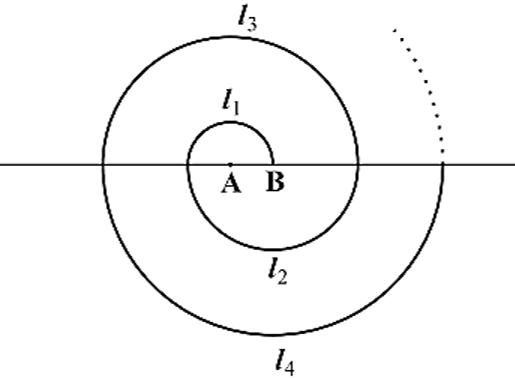
A spiral is made up of successive semicircles, with centres alternately at A and B, starting with centre at A, of radii 0.5 cm, 1.0 cm, 1.5 cm, 2.0 cm, . . . as shown in Fig. 5.4. What is the total length of such a spiral made up of thirteen consecutive semicircles? (Take = 22 7 ) 70 Fig. 5.4 [Hint : Length of successive semicircles is l1, l2, l3, l4, . . . with centres at A, B, A, B, . . ., respectively.]
Key Idea
The radii of the successive semicircles form an arithmetic progression (AP) with first term a = 0.5 cm and common difference d = 0.5 cm. The length of a semicircle of radius r is (π r). Hence the total length = π × (sum of the radii). Use the formula for the sum of the first n terms of an AP and substitute π = 22/7.
Step-by-Step Solution
1. Identify the AP of radii\
The radii are 0.5 cm, 1.0 cm, 1.5 cm, … .
\[ r_k = 0.5 + (k-1)\times0.5 = 0.5k \] for k = 1,2,…,13.
2. Sum of the radii\
Sum of the first n terms of an AP: \[ S_n = \frac{n}{2}\big[2a+(n-1)d\big] \]
Here, n = 13, a = 0.5, d = 0.5.\
\[ S_{13} = \frac{13}{2}\big[2(0.5)+(13-1)(0.5)\big] = \frac{13}{2}\big[1+6\big] = \frac{13}{2}\times7 = 45.5 \text{ cm} \]
(Alternatively, \(S_{13}=0.5\sum_{k=1}^{13}k =0.5\times\frac{13\times14}{2}=45.5\) cm.)
3. Length of each semicircle\
Length of a semicircle of radius r is \(\ell = \pi r\).
Therefore total length \(L\) of 13 semicircles is \[ L = \pi \times S_{13} = \pi \times 45.5 = \frac{91\pi}{2} \] cm.
4. Insert the given value of \(\pi\)\
Given \(\pi = \frac{22}{7}\).\
\[ L = \frac{91}{2}\times\frac{22}{7}=\frac{91\times22}{14}=\frac{2002}{14}=143 \text{ cm} \]
5. Result\
The total length of the spiral consisting of thirteen consecutive semicircles is 143 cm.
The radii are 0.5 cm, 1.0 cm, 1.5 cm, … .
\[ r_k = 0.5 + (k-1)\times0.5 = 0.5k \] for k = 1,2,…,13.
2. Sum of the radii\
Sum of the first n terms of an AP: \[ S_n = \frac{n}{2}\big[2a+(n-1)d\big] \]
Here, n = 13, a = 0.5, d = 0.5.\
\[ S_{13} = \frac{13}{2}\big[2(0.5)+(13-1)(0.5)\big] = \frac{13}{2}\big[1+6\big] = \frac{13}{2}\times7 = 45.5 \text{ cm} \]
(Alternatively, \(S_{13}=0.5\sum_{k=1}^{13}k =0.5\times\frac{13\times14}{2}=45.5\) cm.)
3. Length of each semicircle\
Length of a semicircle of radius r is \(\ell = \pi r\).
Therefore total length \(L\) of 13 semicircles is \[ L = \pi \times S_{13} = \pi \times 45.5 = \frac{91\pi}{2} \] cm.
4. Insert the given value of \(\pi\)\
Given \(\pi = \frac{22}{7}\).\
\[ L = \frac{91}{2}\times\frac{22}{7}=\frac{91\times22}{14}=\frac{2002}{14}=143 \text{ cm} \]
5. Result\
The total length of the spiral consisting of thirteen consecutive semicircles is 143 cm.
Question 19
Hint available
200 logs are stacked in the following manner: 20 logs in the bottom row, 19 in the next row, 18 in the row next to it and so on (see Fig. 5.5). In how many rows are the 200 logs placed and how many logs are in the top row? Fig. 5.5

Key Idea
The numbers of logs in successive rows form an arithmetic progression (AP) with first term $a=20$, common difference $d=-1$. Use the sum formula for an AP: $S_n = \frac{n}{2}[2a+(n-1)d] = \frac{n}{2}(a+l)$, where $l$ is the last term. Set $S_n = 200$ and solve for $n$.
Step-by-Step Solution
1. Identify the AP:
\[ a = 20,\quad d = -1 \]
The $n^{th}$ term (top row) is \[ l = a + (n-1)d = 20-(n-1). \]
2. Write the sum of the first $n$ terms (total logs):
\[ S_n = \frac{n}{2}(a + l) = \frac{n}{2}\bigl[20 + (20-(n-1))\bigr] = \frac{n}{2}(41 - n). \]
3. Equate the sum to the given total of logs (200):
\[ \frac{n}{2}(41 - n) = 200 \]
\[ n(41 - n) = 400 \]
\[ -n^{2} + 41n - 400 = 0 \]
\[ n^{2} - 41n + 400 = 0. \]
4. Solve the quadratic equation:
Discriminant $\Delta = 41^{2} - 4\times400 = 1681 - 1600 = 81$.
\[ n = \frac{41 \pm \sqrt{81}}{2} = \frac{41 \pm 9}{2}. \]
Hence $n = \frac{50}{2}=25$ or $n = \frac{32}{2}=16$.
5. Choose the feasible value of $n$.
Since the bottom row has 20 logs, the maximum possible rows are 20 (when the top row would have 1 log). $n=25$ exceeds this limit, so discard it.
Therefore, $n = 16$ rows.
6. Find the number of logs in the top row:
\[ l = 20 - (n-1) = 20 - 15 = 5. \]
7. Verify:
\[ S_{16} = \frac{16}{2}(20+5) = 8 \times 25 = 200 \] (matches the given total).
Thus, the logs occupy 16 rows, and the topmost row contains 5 logs.
\[ a = 20,\quad d = -1 \]
The $n^{th}$ term (top row) is \[ l = a + (n-1)d = 20-(n-1). \]
2. Write the sum of the first $n$ terms (total logs):
\[ S_n = \frac{n}{2}(a + l) = \frac{n}{2}\bigl[20 + (20-(n-1))\bigr] = \frac{n}{2}(41 - n). \]
3. Equate the sum to the given total of logs (200):
\[ \frac{n}{2}(41 - n) = 200 \]
\[ n(41 - n) = 400 \]
\[ -n^{2} + 41n - 400 = 0 \]
\[ n^{2} - 41n + 400 = 0. \]
4. Solve the quadratic equation:
Discriminant $\Delta = 41^{2} - 4\times400 = 1681 - 1600 = 81$.
\[ n = \frac{41 \pm \sqrt{81}}{2} = \frac{41 \pm 9}{2}. \]
Hence $n = \frac{50}{2}=25$ or $n = \frac{32}{2}=16$.
5. Choose the feasible value of $n$.
Since the bottom row has 20 logs, the maximum possible rows are 20 (when the top row would have 1 log). $n=25$ exceeds this limit, so discard it.
Therefore, $n = 16$ rows.
6. Find the number of logs in the top row:
\[ l = 20 - (n-1) = 20 - 15 = 5. \]
7. Verify:
\[ S_{16} = \frac{16}{2}(20+5) = 8 \times 25 = 200 \] (matches the given total).
Thus, the logs occupy 16 rows, and the topmost row contains 5 logs.
Question 20
Hint available
In a potato race, a bucket is placed at the starting point, which is 5 m from the first potato, and the other potatoes are placed 3 m apart in a straight line. There are ten potatoes in the line (see Fig. 5.6). Fig. 5.6 A competitor starts from the bucket, picks up the nearest potato, runs back with it, drops it in the bucket, runs back to pick up the next potato, runs to the bucket to drop it in, and she continues in the same way until all the potatoes are in the bucket. What is the total distance the competitor has to run? [Hint : To pick up the first potato and the second potato, the total distance (in metres) run by a competitor is 2 × 5 + 2 × (5 + 3)] 71

Key Idea
The distances of the potatoes from the bucket form an arithmetic progression. The total distance run is twice the sum of these distances because the competitor goes to each potato and returns to the bucket.
Step-by-Step Solution
1. Distances of the potatoes from the bucket\
The first potato is $5\,\text{m}$ away. Each subsequent potato is $3\,\text{m}$ farther. Hence the distances form an A.P. with\
\[ a = 5,\quad d = 3,\quad n = 10. \]
The $k^{\text{th}}$ potato is at distance \[ D_k = a + (k-1)d = 5 + (k-1)\times 3 \] meters.
2. Sum of all distances\
Using the sum formula for an A.P.:\
\[ S = \frac{n}{2}\bigl[2a + (n-1)d\bigr] \]
Substituting the values:\
\[ S = \frac{10}{2}\bigl[2\times5 + 9\times3\bigr] = 5\bigl[10 + 27\bigr] = 5\times37 = 185\ \text{m}. \]
So the total of the one‑way distances to all potatoes is $185\,\text{m}$.
3. Total distance run\
For each potato the competitor runs to it and back, i.e., twice the one‑way distance. Hence\
\[ \text{Total distance} = 2 \times S = 2 \times 185 = 370\ \text{m}. \]
4. Verification with the hint\
For the first two potatoes: $2\times5 + 2\times(5+3) = 10 + 16 = 26\,\text{m}$, which matches the method above. Extending the same reasoning to all ten potatoes gives $370\,\text{m}$.
Thus the competitor has to run a total of $370$ metres.
The first potato is $5\,\text{m}$ away. Each subsequent potato is $3\,\text{m}$ farther. Hence the distances form an A.P. with\
\[ a = 5,\quad d = 3,\quad n = 10. \]
The $k^{\text{th}}$ potato is at distance \[ D_k = a + (k-1)d = 5 + (k-1)\times 3 \] meters.
2. Sum of all distances\
Using the sum formula for an A.P.:\
\[ S = \frac{n}{2}\bigl[2a + (n-1)d\bigr] \]
Substituting the values:\
\[ S = \frac{10}{2}\bigl[2\times5 + 9\times3\bigr] = 5\bigl[10 + 27\bigr] = 5\times37 = 185\ \text{m}. \]
So the total of the one‑way distances to all potatoes is $185\,\text{m}$.
3. Total distance run\
For each potato the competitor runs to it and back, i.e., twice the one‑way distance. Hence\
\[ \text{Total distance} = 2 \times S = 2 \times 185 = 370\ \text{m}. \]
4. Verification with the hint\
For the first two potatoes: $2\times5 + 2\times(5+3) = 10 + 16 = 26\,\text{m}$, which matches the method above. Extending the same reasoning to all ten potatoes gives $370\,\text{m}$.
Thus the competitor has to run a total of $370$ metres.